COUPLED presents new research on packed-bed chemical looping reactors at ICCL 2026
07/09/2026

07/09/2026
The COUPLED project contributed to the scientific programme of the 8th International Conference on Chemical Looping (ICCL 2026), held at The University of Manchester from 31 August to 4 September 2026.
ICCL brings together the international chemical looping community to exchange the latest scientific and technological advances in the field. For COUPLED, which is demonstrating an integrated process for renewable fuel production at TRL7, the conference provided an important opportunity to share project research and engage with experts working to advance chemical looping technologies towards industrial application.
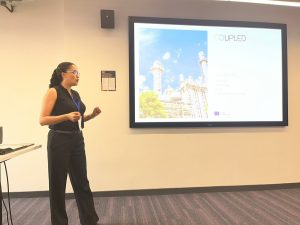
On the third day of the conference, Isabel Pazmino-Mayorga from The University of Manchester presented COUPLED research during the session Chemical Looping Reactor Design.
The presentation, “Operability window in packed-bed chemical looping reactors: influence of oxygen carrier metal loading on heat and reaction front dynamics”, co-authored with Andrew D. Wright and Vincenzo Spallina, explored how oxygen carrier metal loading affects reactor behaviour, heat and reaction front dynamics, and the operational limits of packed-bed chemical looping systems.
The work generated particular interest around the concept of operability maps. While reactor design studies often concentrate on performance, understanding the range of conditions under which a reactor can operate stably and effectively is equally important. Defining these operability windows can therefore provide valuable insights for the design, scale-up and reliable operation of future chemical looping reactors.
The presentation highlighted how research developed within COUPLED is contributing not only to improving chemical looping performance, but also to addressing the practical considerations required to bring these technologies closer to industrial deployment.
Congratulations to Isabel Pazmino-Mayorga, Andrew D. Wright, Vincenzo Spallina and the Department of Chemical Engineering at The University of Manchester for representing COUPLED and contributing to the scientific discussions at ICCL 2026.



Funded by the European Union under the Grant Agreement n° 101235724. Views and opinions expressed are however those of the author(s) only and do not necessarily reflect those of the European Union or CINEA. Neither the European Union nor CINEA can be held responsible for them.